
All your crypto in one place, instead of six tabs and a spreadsheet.
Because crypto never sleeps.
CryptoNight is a concept for how a wallet connector could work: every exchange and wallet aggregated into a single portfolio view. I designed it for fun, to see the idea through end to end.
The idea started in 2019, when my own portfolio was scattered across too many exchanges to track by hand. I sketched a lo-fi first pass in Adobe XD to get the concept down, then let it sit. I came back to it in late 2020, mid-pandemic, and rebuilt it from scratch in Figma with everything I’d learned since.
- Type
- Personal Project
- Focus
- Fintech / Crypto UX
- Tools
- Adobe XD, Figma
Early concept
The first pass, sketched in Adobe XD in 2019.
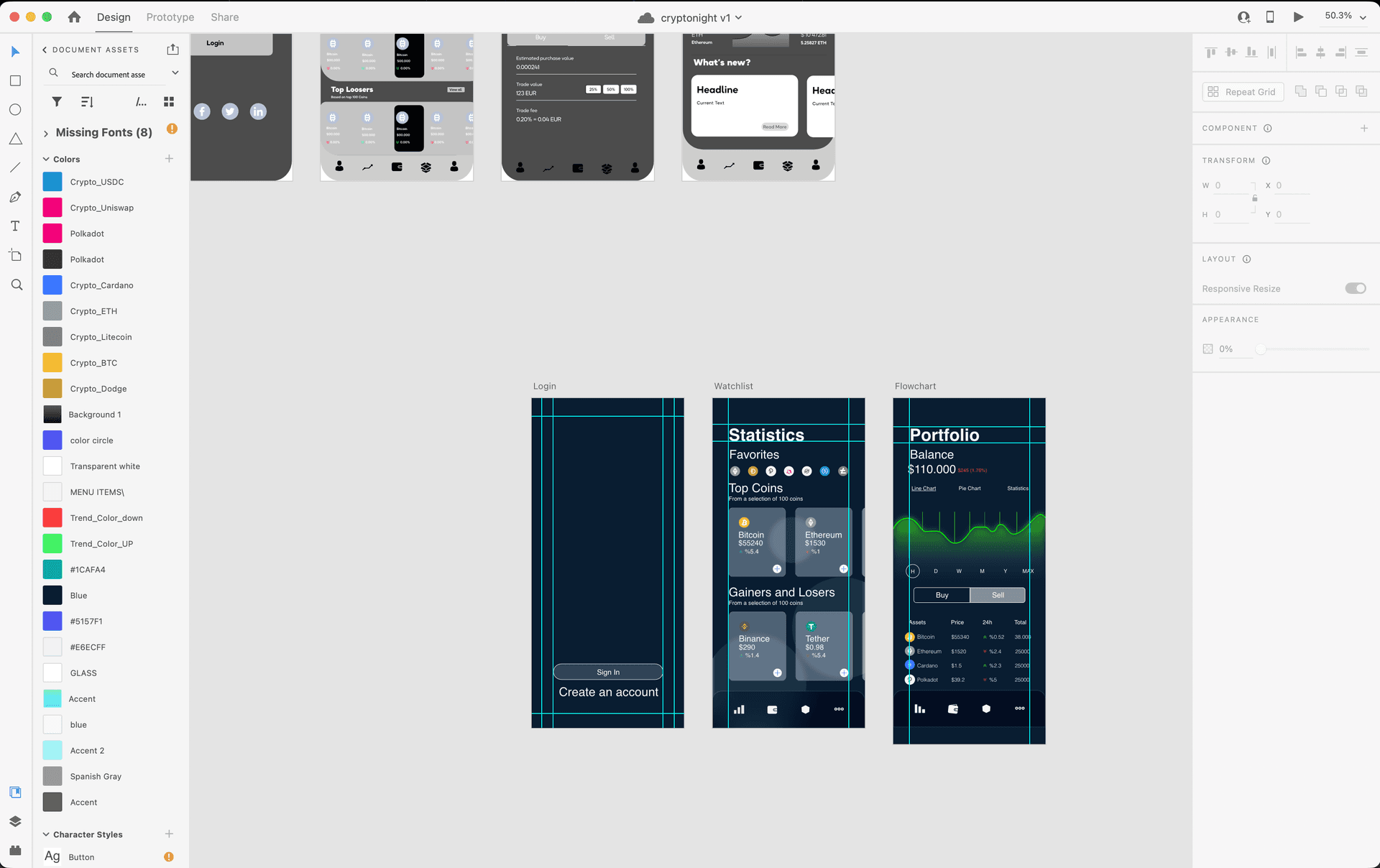
Before the Figma rebuild, this was the original prototype: a watchlist of top gainers and losers, a buy/sell trade screen, and a portfolio balance with a news feed. Most of the ideas held up; the execution didn’t.
The working file
The 2019 Adobe XD file the screen above came from.
Login, Watchlist, and the trade flowchart, laid out in the original XD document before any of it moved to Figma.
The problem
How do you give a multi-exchange trader one honest number for what they own?
Crypto holdings live wherever the user chose to buy: an exchange for spot trading, a hardware wallet for cold storage, a DeFi wallet for staking. Most portfolio trackers either support a narrow set of integrations or ask users to hand over a full-access API key just to see a balance. The design hypothesis was that multi-exchange traders need one number they can trust, updated on its own, without handing over more account access than a balance needs.
Persona
Meet Adrian.
Hypothetical persona for a personal concept, not drawn from formal research.

- Age
- 29
- Occupation
- Product Manager
- Status
- Married
- Location
- Berlin, Germany
Description
Adrian works in fintech and trades across four exchanges plus two hardware wallets. He checks prices constantly but has never had one clean view of what he actually owns, so he keeps track of it by hand in a spreadsheet.
Personality
Tags
Pain points
- Manually copies balances from four exchanges and two wallets into a spreadsheet every week.
- Has no single view of total exposure by asset across every account.
- Missed a rebalancing opportunity because a 20% swing went unnoticed for days.
- Doesn't fully trust a “connect your API key” flow without a clear read-only guarantee.
- Wants a quick answer to a market question without opening six different apps.
Scope
The four things it had to do.
Multi-Wallet Aggregation
Connect exchanges and wallets through read-only API keys, and see one consolidated balance instead of six separate ones.
Real-Time Market Data
A ranked watchlist with live price and 24-hour change, so prices sit right next to the portfolio.
AI-Assisted Research
A chat assistant for quick market questions, with a visible disclaimer on every answer.
Security-First Connections
Read-only access by default, encrypted key storage, and a visible toggle, so people can see how their keys are protected.
Competitive landscape, 2019 — 2020
The gap between what existed then and what multi-exchange traders needed.
CoinStats
At the time, broad exchange support, but a cluttered interface that buried the total balance under promotional content.
Zerion
At the time, clean DeFi wallet tracking, but weak support for centralized exchange balances.
Delta
At the time, simple tracking built mostly around manually entered trades, so holdings drifted out of date between updates.
Zoomed out, price data, portfolio tracking, and wallets were three separate categories in 2019 and 2020, each solving one piece of the problem and none of them the whole thing.
| Platform | Category | Role |
|---|---|---|
| CoinMarketCap | Market Data | The default price reference at the time; no portfolio tracking of its own. |
| CoinGecko | Market Data | Broader coin coverage than CoinMarketCap, but still just prices, not a portfolio view. |
| Blockfolio | Portfolio Tracker | The most popular mobile tracker at the time, built around manual entry. |
| MetaMask | Wallet | Browser-based Ethereum wallet with no cross-exchange or cross-chain view. |
| Trust Wallet | Wallet | Mobile multi-chain wallet, still one wallet at a time, no aggregation. |
CryptoNight’s angle
Read-only connections to both wallets and exchanges, plus an assistant you can ask about a coin without leaving the app.
Screens
Six screens from the Figma build.
Sign In
Email sign-in, with Google and Apple as one-tap options.
Portfolio
Total balance across every connected wallet, plus a per-wallet breakdown by asset.
Watchlist
Ranked market data with live price and 24-hour change, at a glance.
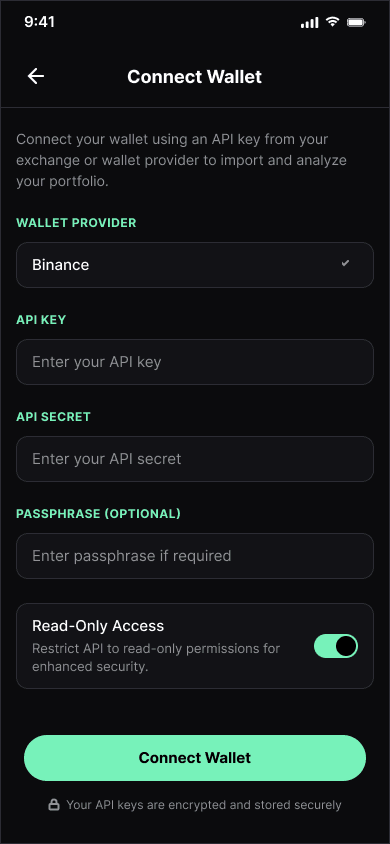
Connect Wallet
API-key connection to an exchange or wallet, read-only by default, with encrypted key storage.
Assistant
A chat interface for market questions, with a clear disclaimer that it's analysis, not financial advice.
News
A filtered news feed, tagged by asset and topic, surfaced next to the portfolio it affects.
Light & dark mode
Designed for any hour.
Traders check prices at all hours, so I designed every screen in both themes from the start. Drag each screen to compare.
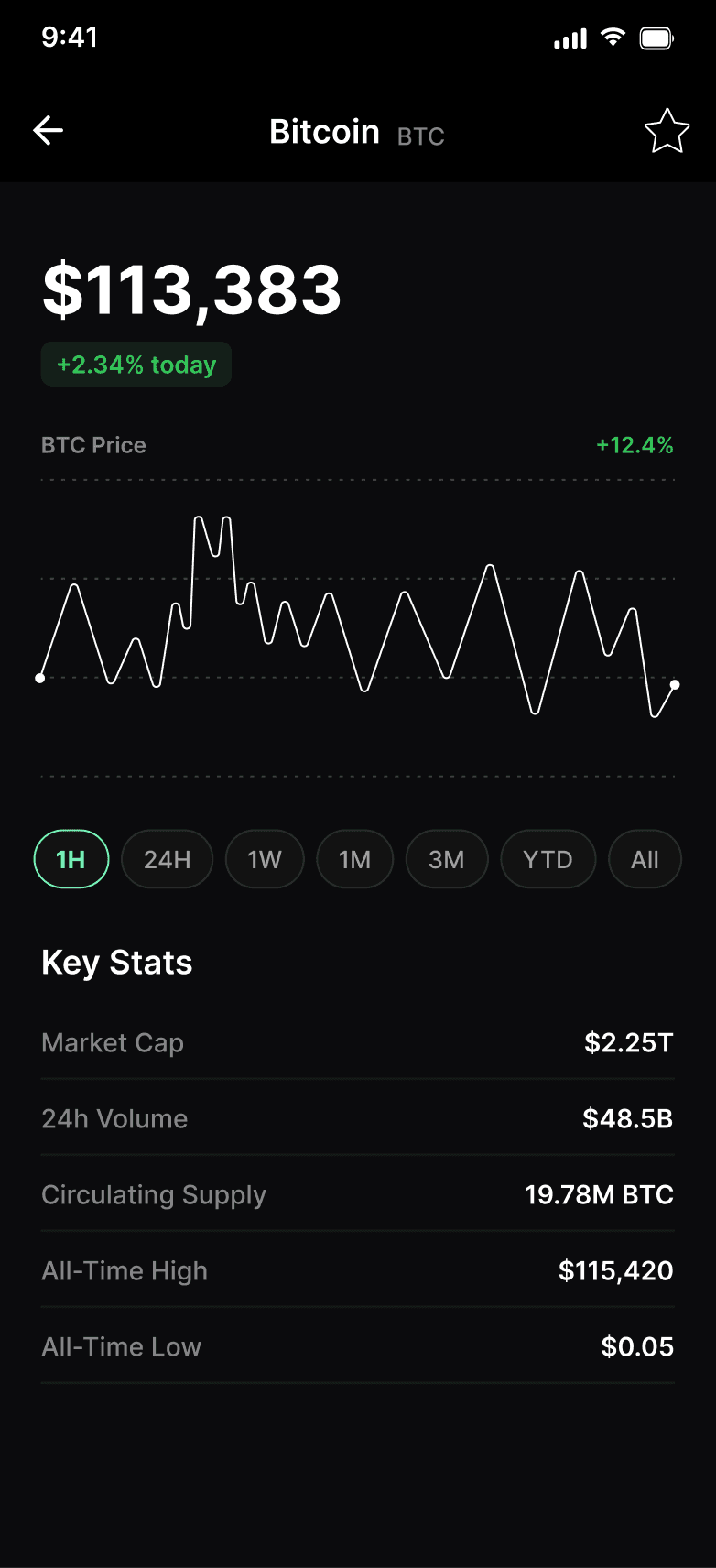 Dark
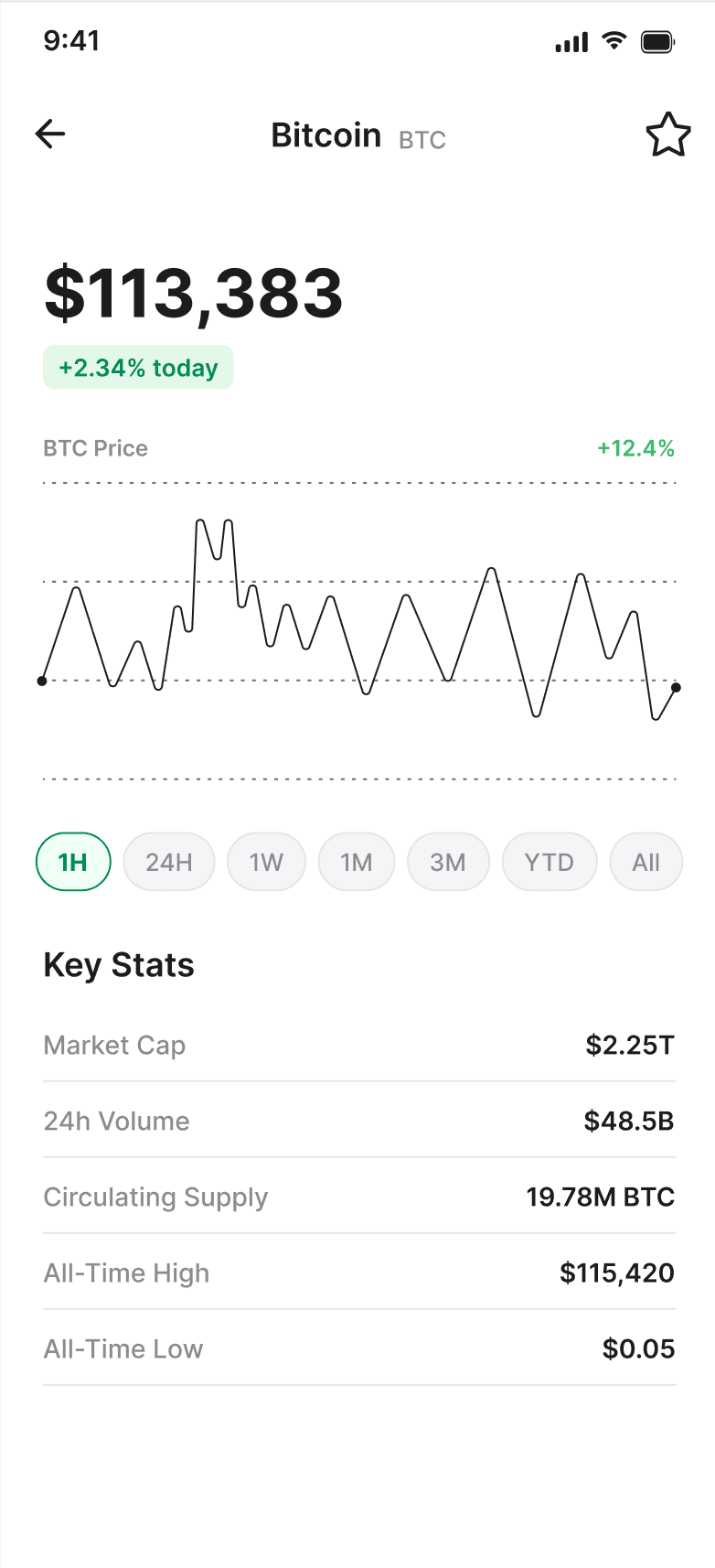 Light
Coin detail
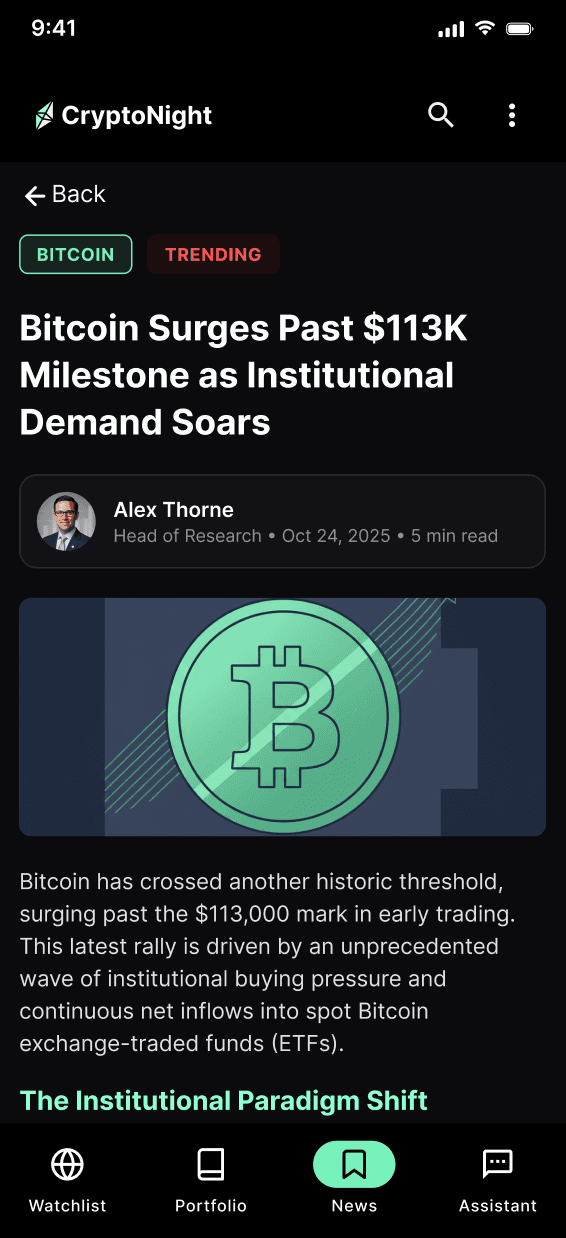 Dark
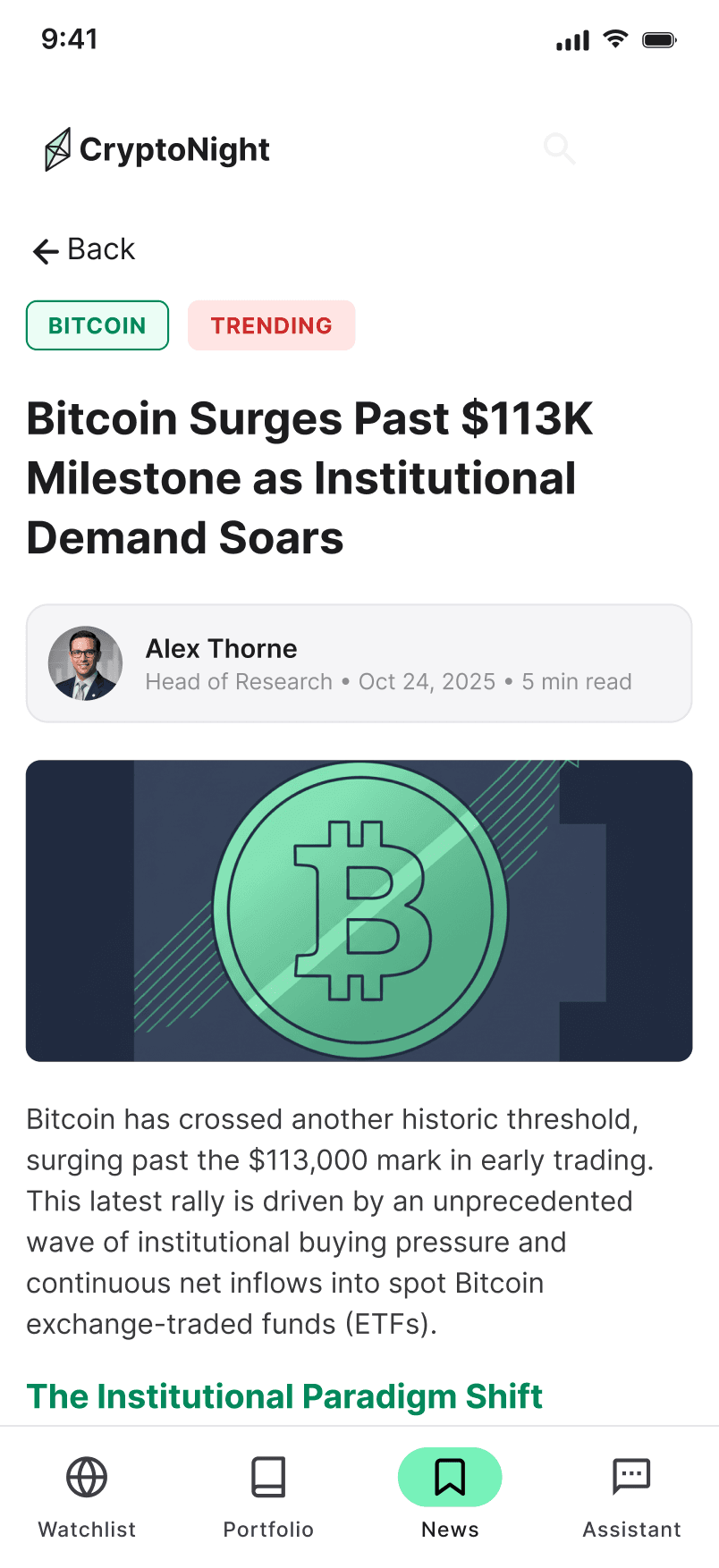 Light
Article
Brand guidelines
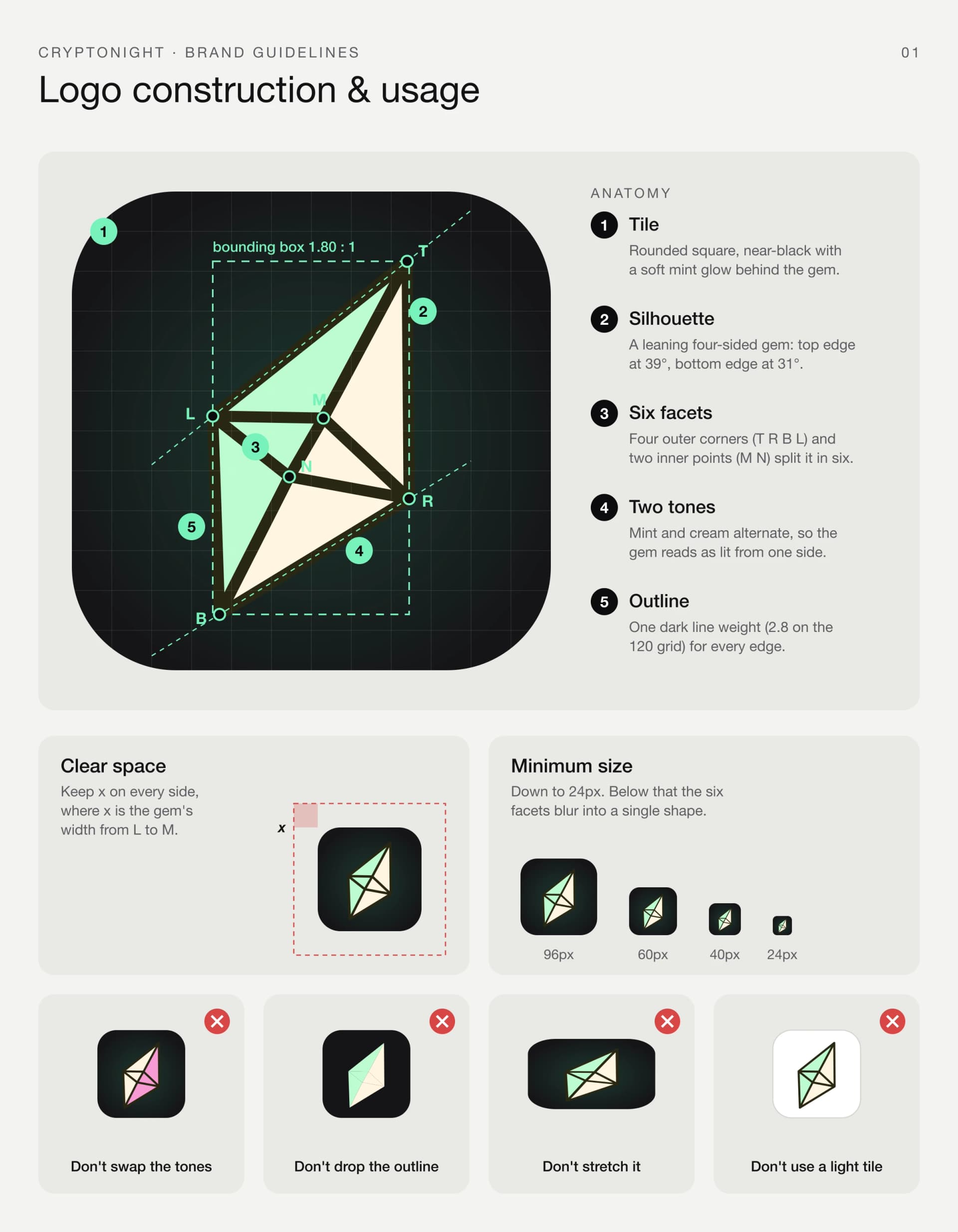
A crystal that glows in the dark.
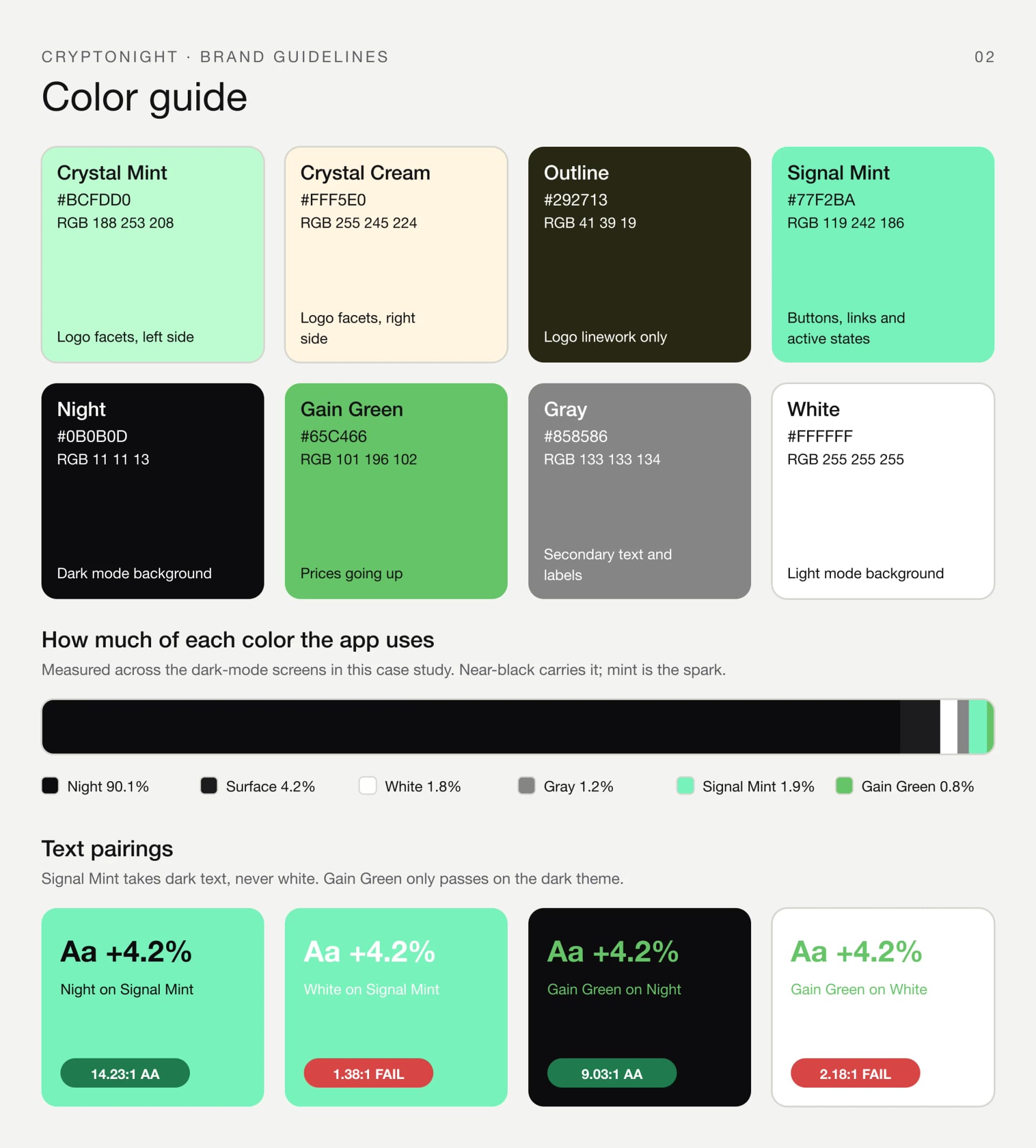
The mark is a six-facet gem on a near-black tile, drawn to sit right at home in the dark theme. Below: the geometry behind it, and where its mint shows up across the app.
Component library
Built from a handful of parts.
Every screen is put together from the same few components: six colors, one typeface, one pill shape. Here they are as live components, so the chips, switch and tabs below all work.
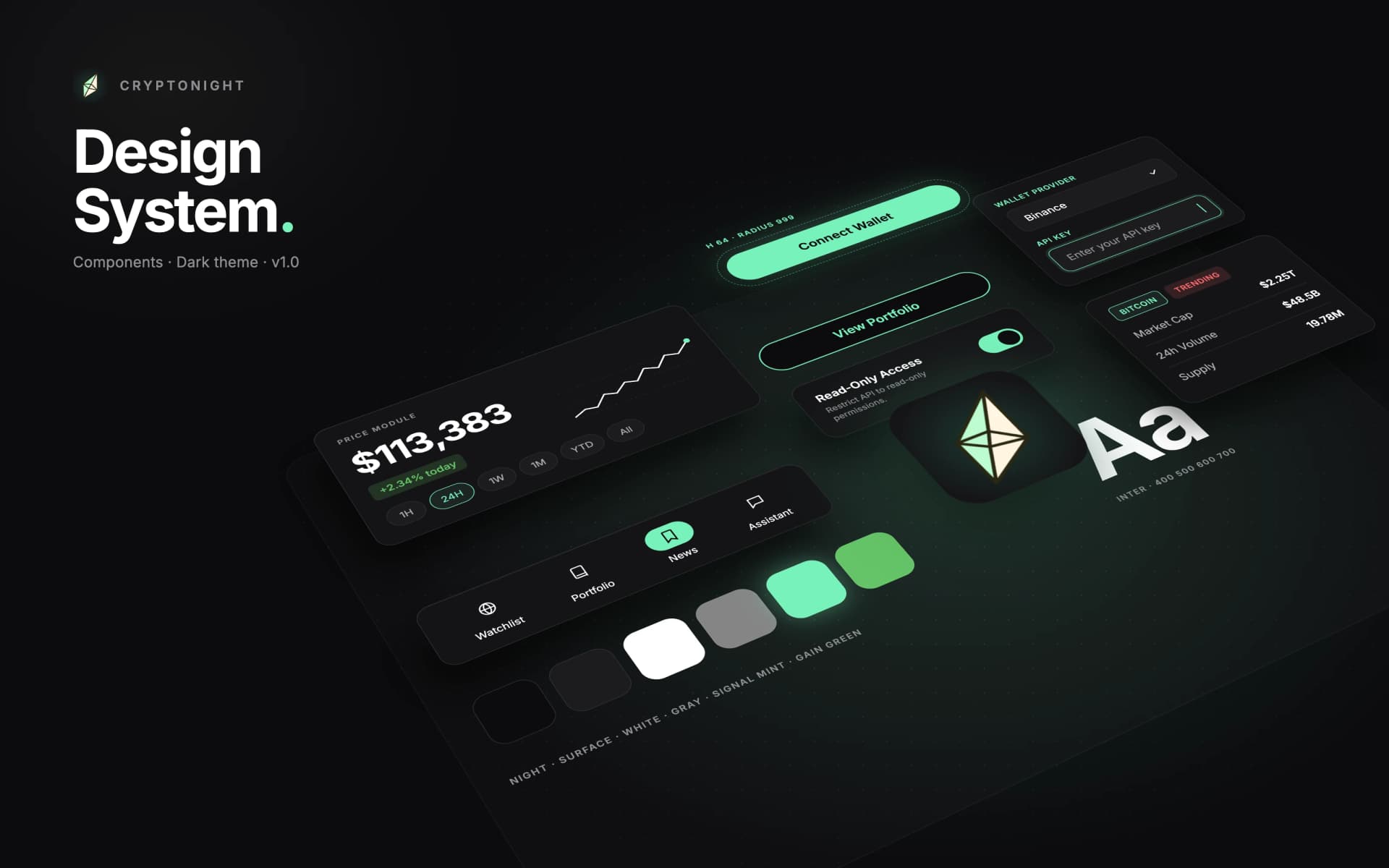
Color
Type · Inter
$113,383Display 32 / Bold
Key StatsTitle 20 / Semibold
Market CapBody 15 / Regular
API KEYLabel 12 / Semibold caps
Price module
$113,383
+2.34% todayButtons
Form fields
Toggle row
Stat list & tags
- Market Cap
- $2.25T
- 24h Volume
- $48.5B
- Circulating Supply
- 19.78M BTC
Tab bar
Prototype
Tap through the Figma prototype.
An interactive prototype starting from the Portfolio screen, built in Figma.
Closing note
A problem I actually have.
No client and no deadline. Just something I live with: too many exchanges and wallets and no single number I can trust.